Which 2026 TOEFL questions people actually get wrong
Guides tell you what each task asks. This page tells you which ones people miss. Every question answered on ExamStep is marked against the answer key and tagged with what it was testing, so the accuracy below is counted, not estimated — and one task is far harder than its share of the test suggests.
What was counted
1,887 questions across 423 practice sets, answered by 25 people between 14–22 September 2026, each marked against the answer key. Staff accounts are excluded. Percentages are of questions, not of sets, and every row carries the number of questions and the number of people behind it — read the thin rows as a direction and the fat ones as a number.
This is early data about a test that only changed in 2026, over nine days. It says what our practice material found; it is not a study of the official test, and ETS has nothing to do with it. The page is a snapshot of the window named above, not a live feed — when we refresh it, the dates move with the numbers.
The new task is the hard one
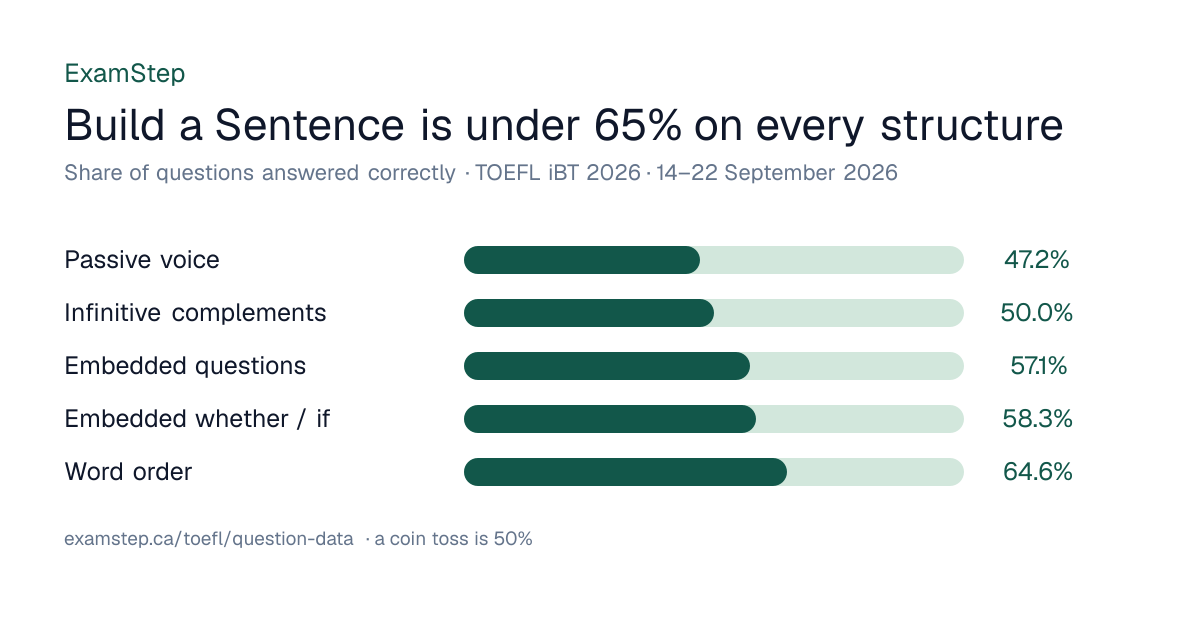
Build a Sentence asks you to order fragments into a grammatical sentence. It is new in 2026, which means almost nobody arrives having practised it — and it is the only place on the test where a single grammar rule decides the mark outright. Every structure it put under test came in below 65%.
Passive voice
47.2%36 questions · 12 people
Infinitive complements
50.0%24 questions · 12 people
Embedded questions
57.1%84 questions · 19 people
Embedded whether / if clauses
58.3%48 questions · 19 people
Word order
64.6%48 questions · 12 people
The passive at 47.2% is worse than a coin toss, and infinitive complements at 50.0% are exactly one. Both are structures that reorder who does what to whom — the thing an ordering task is built to catch. These five rows rest on 12 to 19 people, so treat them as a strong hint rather than a settled fact; they are also the rows we expect to move most as more people sit the task.
What a question asks decides how often it is missed
Across Reading and Listening together, accuracy tracks what the question demands rather than which section it sits in. Retrieving something the text says is comfortable. Working out how the text is built, or what it implies, is not.
Sentence insertion
43.8%48 questions · 23 people · where a given sentence belongs in the passage
Inference
61.1%54 questions · 23 people · what follows from the text but is never stated
Vocabulary in context
66.9%528 questions · 23 people · the word the sentence needs
Rhetorical purpose
69.0%129 questions · 23 people · why the writer or speaker said it
Pragmatics
75.3%231 questions · 20 people · what the speaker means, not what they said
Specific detail
82.0%534 questions · 23 people · a fact stated in the text
Main idea
85.1%87 questions · 23 people · what the whole thing is about
Cause and effect
97.2%36 questions · 23 people · which thing led to which
Sentence insertion is the hardest question type on the test at 43.8% — the only one below half. It is also the only one that asks about structure rather than content: you have to hold the argument of the passage in your head and find the seam it fits into. Inference follows at 61.1%. At the other end, specific detail (82.0%) and main idea (85.1%) are close to solved.
The practical reading of this: time spent re-reading for facts is time spent on the questions you were going to get anyway.
Accuracy by task
The same pattern one level up. What separates an easy task from a hard one is register: conversational material sits in the 80s and 90s, academic material in the 60s.
Reading
Complete the Words
67.1%480 questions · 23 people
240 questions · 23 people
Read in Daily Life
99.5%192 questions · 23 people · sets of 2–3 questions
Read in Daily Life at 99.5% is not a typo, and it is worth understanding rather than celebrating: these are notices, messages and schedules in sets of two or three questions, and 71 of 72 sets were perfect. Complete the Words is the opposite — 30 of Reading's 50 items in the official blueprint, and our weakest reading task at 67.1%. The largest task on the section is also the one people miss most.
Listening
252 questions · 20 people
84 questions · 20 people
Choose a Response
75.3%231 questions · 20 people
168 questions · 20 people
A conversation between two people is comfortable at 82.1%. The same listener drops sixteen points on an academic talk. Nothing about the audio is faster; what changes is that the talk carries an argument, and the questions ask about the argument.
Questions about this data
What is the hardest part of the 2026 TOEFL?
On our own marking, Build a Sentence. Every one of the five grammar structures it tests comes in under 65% correct — the passive at 47.2% and infinitive complements at 50.0% — while ordinary comprehension questions such as specific detail (82.0%) and main idea (85.1%) sit far above. It is also the newest task on the test, so almost nobody has practised it.
Which TOEFL question type do people get wrong most often?
Sentence insertion — placing a given sentence at the right point in a passage — at 43.8% correct across 48 questions. It is the only comprehension question type that lands below half, and it is the one that depends on how a passage is built rather than on what it says.
Is TOEFL Listening harder than Reading?
They are closer than people expect, and the difficulty sits inside the task rather than the skill. Listen to an Academic Talk is our weakest listening task at 65.9%, Complete the Words our weakest reading task at 67.1%. What separates easy from hard is register: conversational material scores in the 80s and 90s, academic material in the 60s.
How much data is this based on?
1,887 questions in 423 practice sets, answered by 25 people between 14–22 September 2026, marked against the answer key. Staff accounts are excluded. It is early data on a test that only changed in 2026, and the page says on every row how many questions and how many people stand behind it.
Accuracy figures are counted from questions answered on ExamStep and marked against the answer key, staff accounts excluded, for the window named above. Task names, item counts and the section blueprint are ETS, TOEFL iBT Test: 2026 Update — Test Blueprint and Specifications, checked 5 September 2026. No question, passage or recording is reproduced. ExamStep is an independent practice resource and is not affiliated with ETS. TOEFL® and TOEFL iBT® are registered trademarks of Educational Testing Service. Anyone is welcome to cite these figures with a link to this page.
In this series: the whole 2026 format · what changed · Reading · Listening · Writing · Speaking · the 1–6 score scale.
Free reading practice, with answers
A complete worked example for every reading task type — the prompt, every question with its answer, and why the other options fail. No account needed.